

Published: April 20, 2026 by: Rungrueng Hounraluek
What is FTTx?
FTTx (Fiber To The x) is a collective term for network technologies that use fiber optic cables as the primary medium for transmitting high-speed data from the network center to the end point of use. The letter x refers to different end locations, such as a home, building, room, or distribution point. The concept of FTTx is to migrate infrastructure from traditional copper wiring to fiber in order to achieve higher speed, greater stability, and support for modern applications such as IPTV, Cloud, IoT, and Smart Buildings.
Common types of FTTx include FTTH (Fiber To The Home), which runs fiber directly to the house; FTTB (Fiber To The Building), which reaches the building and then distributes internally; FTTC (Fiber To The Curb), which reaches a cabinet near the home and then continues over copper; FTTN (Fiber To The Node), which reaches a neighborhood node; and FTTR (Fiber To The Room), a newer model in which fiber is extended to every room for maximum performance. Each type is selected based on budget, building structure, and the desired level of performance. FTTH and FTTR are considered modern standards that currently offer the best user experience.
What is PON?
PON (Passive Optical Network) is a fiber optic network architecture with no electrically powered devices in the middle of the transmission path. It is used to deliver data from the network center to multiple end users over a single fiber line. A PON system consists of three main components: the OLT (Optical Line Terminal) at the source, a splitter for signal distribution, and the ONU/ONT at the user end. The key concept of PON is to share the signal from the source among multiple users, which reduces infrastructure costs and energy consumption because there are no active devices at intermediate points.
A PON-based fiber network can efficiently provide high-speed internet access as well as other services such as IPTV, VoIP, and Smart Building systems. Data transmission is managed so that each user receives bandwidth appropriately. PON has therefore become the core of modern FTTx systems and is the main standard used by internet service providers and organizations to build fiber networks that are stable, cost-effective, and future-ready.
Why are EPON FTTX and GPON FTTX different?
The starting point of the difference between EPON FTTX and GPON FTTX is not speed or equipment, but rather who defined the standard, which directly reflects the design philosophy of each system. EPON FTTX was developed under IEEE, the organization long associated with Ethernet and IT networking standards. IEEEs core philosophy is to create standards that are simple, flexible, and widely applicable. As a result, EPON FTTX uses native Ethernet frames with minimal modification to the data structure, making it easy for network engineers to understand and deploy, almost like extending a LAN over fiber.
GPON FTTX, on the other hand, was developed under ITU-T, the International Telecommunication Union standardization sector, which focuses specifically on telecom operator networks. ITU-Ts concept is to build networks that can simultaneously support multiple services such as internet, telephone, and television (Triple Play). Therefore, GPON uses a more sophisticated data structure and control mechanisms, such as dynamic bandwidth allocation and carrier-grade QoS, enabling it to support a large number of users with high stability.
Because they originated from different worlds, EPON FTTX and GPON FTTX have clearly different DNA. EPON FTTX grew out of the IT world, which emphasizes simplicity and cost efficiency, while GPON FTTX comes from the telecom world, which emphasizes stability, control, and large-scale expansion. This fundamental difference is the basis for everything that follows, including performance, real-world applications, and even deployment strategies across industries.
What is the EPON FTTX standard under IEEE?
EPON FTTX originated from the IT-side idea of extending Ethernet farther than before. It was developed under IEEE, the global standards organization for computer networking. A major turning point came in 2004 with the publication of IEEE 802.3ah, known as Ethernet in the First Mile. The main idea was to apply Ethernet frames, commonly used in LAN systems, directly over fiber networks. This made the structure simple, reduced complexity, and allowed immediate extension from existing network engineering knowledge.
During 20052010, EPON FTTX began to see widespread real-world deployment in Asian countries such as Japan and China because of its low cost and fast installation. Internet service providers (ISPs) could expand fiber networks without very high investment. This was the period in which EPON FTTX grew rapidly as an FTTH solution for markets that valued cost-effectiveness more than system complexity.
Later, during 20102015, the technology evolved into IEEE 802.3av, increasing speeds to the 10 Gbps level to support bandwidth-intensive applications. Although performance improved significantly, the core philosophy of EPON FTTX remained the same: simplicity, ease of use, and reliance on Ethernet architecture. This makes it well suited for enterprise environments, campus networks, or projects that require tight budget control.
Today, EPON FTTX continues to play a role in niche markets such as apartment buildings, factories, and internal enterprise networks, where its strengths are cost efficiency and flexibility. Although it is not the primary nationwide operator standard like GPON FTTX, the evolution of EPON FTTX clearly shows that the technology was designed to deliver simplicity and value from the standards level to real-world deployment.
Evolution of EPON FTTX (IEEE Family)
| EPON FTTX Evolution (IEEE Family) | |||
| Name | Standard | Speed | Status |
| EPON FTTX (1G) | IEEE 802.3ah | 1.25/1.25 Gbps | Widely deployed |
| 10G-EPON FTTX | IEEE 802.3av | 10G/1.25G | Used in some markets |
| 10G-EPON Symmetric FTTX | IEEE 802.3av | 10G/10G | Deployed, but not widespread |
| 25G/50G EPON FTTX | IEEE Roadmap | 25G & 50G | Under development |
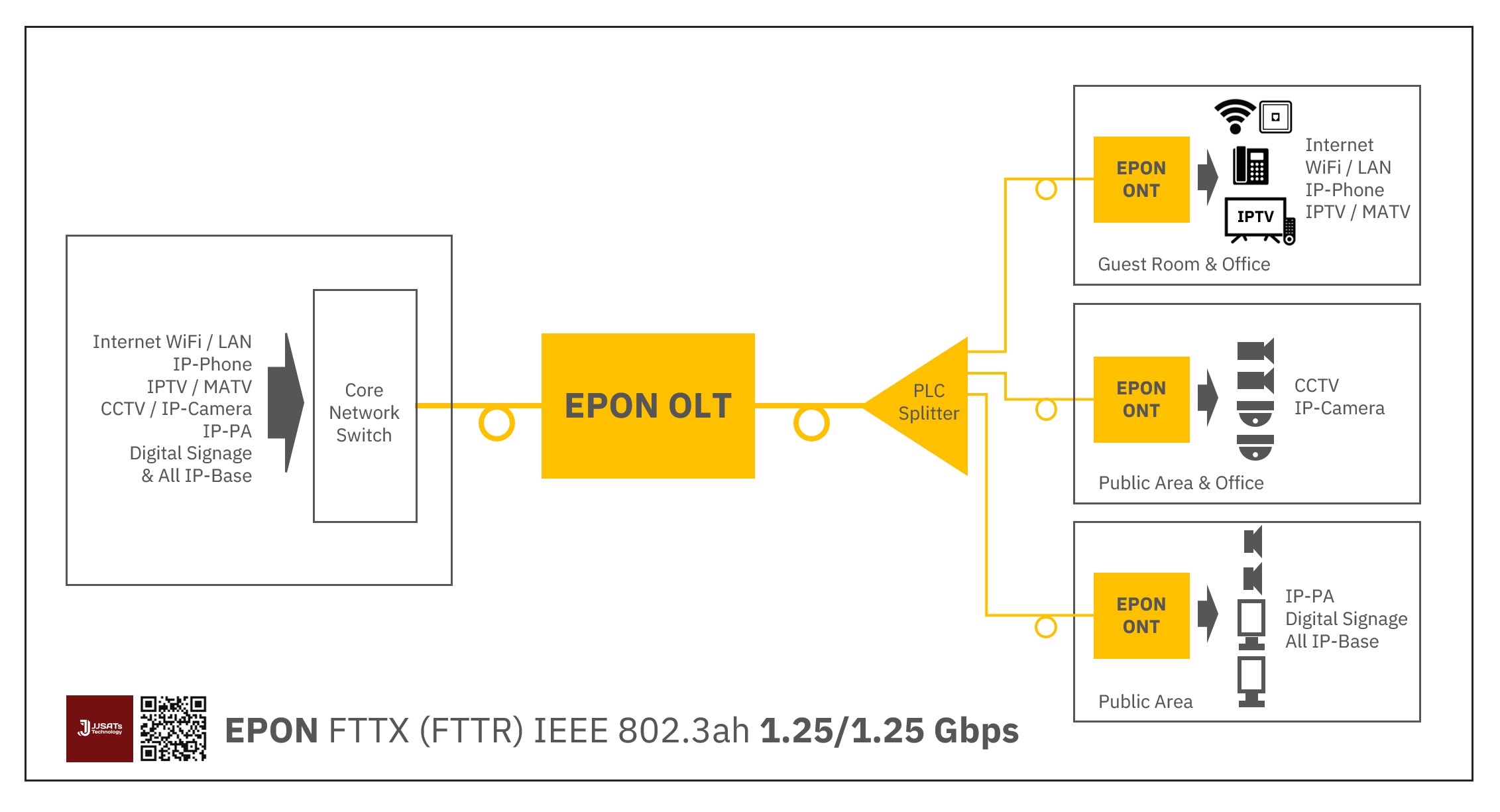
The evolution of EPON FTTX under IEEE began with IEEE 802.3ah, which offered speeds of about 1.25 Gbps and emphasized native Ethernet for simplicity and low cost. This made it highly popular in the early stage, especially in markets that wanted to expand their networks quickly. It later evolved into IEEE 802.3av, increasing speeds to the 10 Gbps level to support higher-bandwidth applications. Although both asymmetric and symmetric modes exist, commercial deployments have generally favored higher downstream capacity. More recently, development has moved toward 25G and 50G EPON FTTX for future needs. However, real-world adoption still remains concentrated mainly on EPON FTTX (1G) and 10G-EPON FTTX, reflecting IEEEs approach of prioritizing continuity, simplicity, and cost-effectiveness over abrupt increases in system complexity.
What is the GPON FTTX standard under ITU-T?
- GPON FTTX originated from the development of fiber access networks in the telecommunications world under ITU-T. In the early stage (late 1990s to early 2000s), BPON was used, based on ATM architecture. Although it could support multiple services, it had limitations in performance and high complexity, making it unsuitable for large-scale network expansion. ITU-T therefore developed an entirely new concept, resulting in the ITU-T G.984 standard during 20032008. This introduced the GEM frame structure and dynamic bandwidth allocation mechanisms (T-CONT), enabling more efficient and stable support for Triple Play services (Internet, Voice, IPTV).
- During 20082015, GPON FTTX was rapidly adopted worldwide and became the main FTTH standard for internet service providers (ISPs), because it could support a large number of users while also providing precise QoS, making it suitable for services requiring high continuity such as IPTV and VoIP. This period can be considered the golden age of GPON FTTX, as it replaced copper-based infrastructure and earlier technologies in many countries around the world.
- From around 2015 onward, ITU-T advanced GPON FTTX into the 10G era with the ITU-T G.987 standard and further extended it through ITU-T G.9807.1, which supports symmetric 10G/10G speeds. This evolution addresses modern applications such as Cloud, IoT, CCTV, and Smart Buildings, where large volumes of both upstream and downstream traffic are required. QoS and Dynamic Bandwidth Allocation capabilities have also continued to improve, providing better support for real-time applications.
- Today and into the future, GPON FTTX continues to evolve toward 25G and 50G PON to support long-term digital infrastructure, including Smart Cities, AI Infrastructure, and Ultra Broadband. Overall, the evolution of GPON FTTX reflects ITU-Ts philosophy of emphasizing stability, control, and support for massive-scale expansion. This is why GPON FTTX and its successor technologies remain the core of global fiber infrastructure today.
Evolution of GPON FTTX (ITU-T Family)
| Evolution of the GPON FTTX Family | |||
| Name | Standard | Speed | Status |
| BPON (pre-GPON FTTX) | ITU-T G.983 | ~622 Mbps | Obsolete |
| GPON FTTX | ITU-T G.984 | 2.5G / 1.25G | Widely deployed |
| XG-PON FTTX | ITU-T G.987v | 10G / 2.5G | Used in some projects |
| XGS-PON Symmetric FTTX | ITU-T G.9807.1 | 10G / 10G | Becoming the new standard |
| 25G / 50G PON FTTX | ITU-T Roadmap | 25G & 50G | High-end deployment |
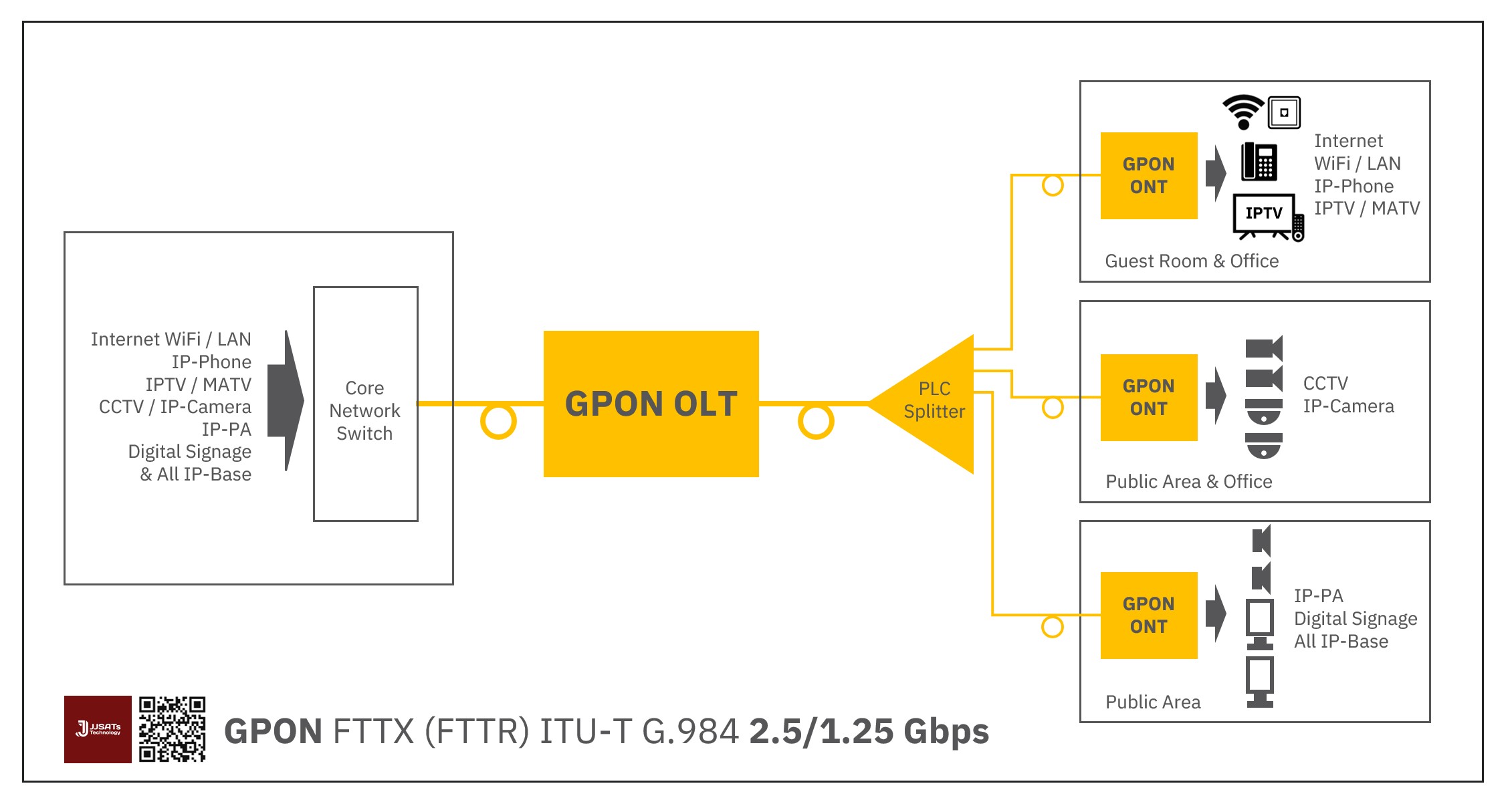
- The evolution of GPON FTTX under ITU-T began with BPON, which used an ATM-based structure but had performance limitations. It was then developed into ITU-T G.984, providing 2.5 Gbps downstream and 1.25 Gbps upstream while efficiently supporting Triple Play services. As bandwidth demand increased, ITU-T G.987 was introduced, increasing download speeds to 10 Gbps, and was later followed by ITU-T G.9807.1, which provides symmetric 10 Gbps upstream and downstream. This fully supports modern applications such as Cloud, IoT, and Smart Buildings. Today, development continues toward 25G and 50G PON to support future infrastructure, showing that GPON FTTX is not just a single technology, but a continuously evolving family of carrier-grade solutions for global network expansion.
- Ultimately, the difference between EPON FTTx and GPON FTTx is not only about speed figures, but about the foundation of the design philosophy from the standardization stage onward. The IT side emphasizes simplicity and cost-effectiveness, while the telecom side emphasizes stability, strong system control, and large-scale scalability. When considering the evolution of both technologies, it becomes clear that EPON FTTx is well suited to projects requiring flexibility and low cost, while GPON FTTx and its successors are designed to serve as the main infrastructure of the digital world in the long term. Therefore, choosing between them is not simply about selecting a technology, but about selecting a system philosophy that aligns with the projects goals and the future growth of each business.
References (APA Style)
- International Telecommunication Union. (2008). Gigabit-capable passive optical networks (GPON FTTX): General characteristics (ITU-T G.984). ITU-T.
- Institute of Electrical and Electronics Engineers. (2004). IEEE Standard 802.3ah: Ethernet in the First Mile. IEEE.
- Kramer, G., Mukherjee, B., & Pesavento, G. (2002). Ethernet passive optical network (EPON FTTX): Building a next-generation optical access network. IEEE Communications Magazine, 40(2), 6673.
- Maier, M. (2008). NGN architectures, protocols and applications. Wiley.
- Cisco Systems. (2016). GPON FTTX Fundamentals and Architecture. Cisco White Paper.


