Published: April 20, 2026 by: Rungrueng Hounraluek
TV and Satellite Signal Splitters Can Be Divided into 2 Types
1. Splitter (TV SAT Splitter)
A splitter (TV & Satellite Splitter) is a device used to divide a TV or satellite signal equally into multiple output ports. Commonly used models include 2-way, 3-way, 4-way, 6-way, and 8-way splitters.
- A splitter has 1 input port and multiple output ports. The signal level from every output port is equal.
- The more output ports there are, the greater the insertion loss.
Examples of how to calculate input and output signal levels for a splitter: - If a 90 dB signal is fed into a 4-way splitter, the output signal at each port is approximately 90 - 8 = 82 dB
· - If a 90 dB signal is fed into an 8-way splitter, the output signal at each port is approximately 90 - 12.5 = 77.5 dB
Typical Applications of Splitters:
- Used for main signal distribution in a buildings vertical riser system to distribute the signal to each floor
- Used at the end point of a cable line to split the signal to multiple TVs
- Suitable for locations that require equal signal levels at every point
TV or satellite signal splitter available in 2-way, 3-way, 4-way, 6-way, and 8-way versions
Table showing signal loss values of TV or satellite splitters
2. Tap-off (TV SAT Tap-off) A tap-off (TV & Satellite Tap-off) is a TV or satellite signal distribution device designed to extract part of the signal from the main cable line through the tap ports, while still allowing the remaining signal to continue to the next point through the output port. Commonly used models include 1-way, 2-way, 4-way, 6-way, and 8-way tap-offs.- A tap-off has 1 input port
- A tap-off has 2 types of output ports:
- Output port: used to pass the signal onward (low loss)
- Tap ports: used to connect to TVs (higher loss)
- Tap-offs come in various tap loss values so that signal levels at the beginning and end of the system can remain close to each other
- 1-way tap-offs are available with tap loss values of -10, -15, and -20 dB
- 2-way tap-offs are available with tap loss values of -12, -15, and -20 dB
- 4-way tap-offs are available with tap loss values of -12, -15, and -20 dB
- 6-way tap-offs are available with tap loss values of -16 and -20 dB
- 8-way tap-offs are available with tap loss values of -16 and -20 dB
Examples of how to calculate input and output signal levels for a tap-off:- If a 100 dB signal is fed into a 4-way tap-off model TAPS412, the output port signal is approximately 100 - 3 = 97 dB, and the tap port signal is approximately 100 - 12 = 88 dB (can distribute to 4 TVs and still pass onward at 97 dB)
- If a 100 dB signal is fed into a 4-way tap-off model TAPS420, the output port signal is approximately 100 - 2 = 98 dB, and the tap port signal is approximately 100 - 20 = 80 dB (can distribute to 4 TVs and still pass onward at 98 dB)
- If a 100 dB signal is fed into an 8-way tap-off model TAPS816, the output port signal is approximately 100 - 5 = 95 dB, and the tap port signal is approximately 100 - 16 = 84 dB (can distribute to 8 TVs and still pass onward at 95 dB)
- If a 100 dB signal is fed into an 8-way tap-off model TAPS820, the output port signal is approximately 100 - 3 = 97 dB, and the tap port signal is approximately 100 - 20 = 80 dB (can distribute to 8 TVs and still pass onward at 97 dB)
Typical Applications of Tap-offs:- Used in sub-main distribution lines
- Used in horizontal building distribution or floor wiring systems to distribute signals to each TV point
- Helps balance the signal so that each room receives a similar signal level
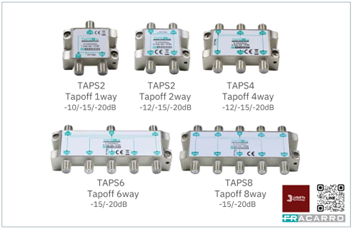
- TV or satellite tap-off available in 1-way, 2-way, 4-way, 6-way, and 8-way versions
Table showing signal loss values of TV or satellite tap-offs
Easy-to-Understand Summary of the Difference Between Splitter and Tap-off
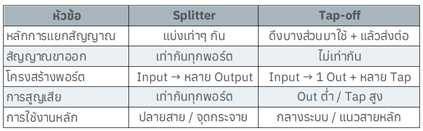
In summary, a splitter (TV SAT Splitter) is a device used to divide a TV or satellite signal from one cable into multiple paths, such as 2-way, 3-way, 4-way, 6-way, and 8-way. The signal level from each output port is equal. However, the more output ports there are, the greater the insertion loss becomes. This type of device is therefore commonly used in main distribution systems and at the end sections of a distribution network (sub-main distribution) to deliver signals to each TV point.
A tap-off (TV SAT Tap-off), on the other hand, is designed to extract part of the signal from the main cable while still allowing the remaining signal to continue to farther points through the output port, which has low loss. The tap ports used to connect to TVs have higher loss and are available in several levels such as -10, -12, -15, and -20 dB, allowing system designers to control and balance the signal level at each point as closely as possible.
For this reason, tap-offs are commonly used in the middle section of a distribution line (sub-main distribution), especially in multi-story buildings or systems that require consistent signal levels at every point. The information is referenced from products of the FRACARRO brand from Italy, with JJSATs as the distributor in Thailand. For consultation on MATV, SMATV, and Hotel IPTV system design, please contact 061-992-6993.


