

Published: May 15, 2026 By: Rungruang Huanraluek
Standalone AP vs Controller-Based AP vs Cloud Managed AP: Whats the difference? Choosing the right Wi-Fi management system for your organization
Today, Wi-Fi systems are no longer just internet broadcasting devices, but have become a critical part of the IT and network infrastructure for organizations, hotels, hospitals, factories, offices, as well as Smart Buildings and various IoT systems. Therefore, in addition to choosing Wi-Fi speed or standards, the "Access Point management format" or Management System is another key factor affecting efficiency, maintenance convenience, and future network scalability.
Currently, Access Points can be divided into 3 main management formats: Standalone Access Point, Controller-Based Access Point, and Cloud Managed Access Point. Each type is suitable for different usage characteristics and organizational sizes.
What is a Standalone Access Point?
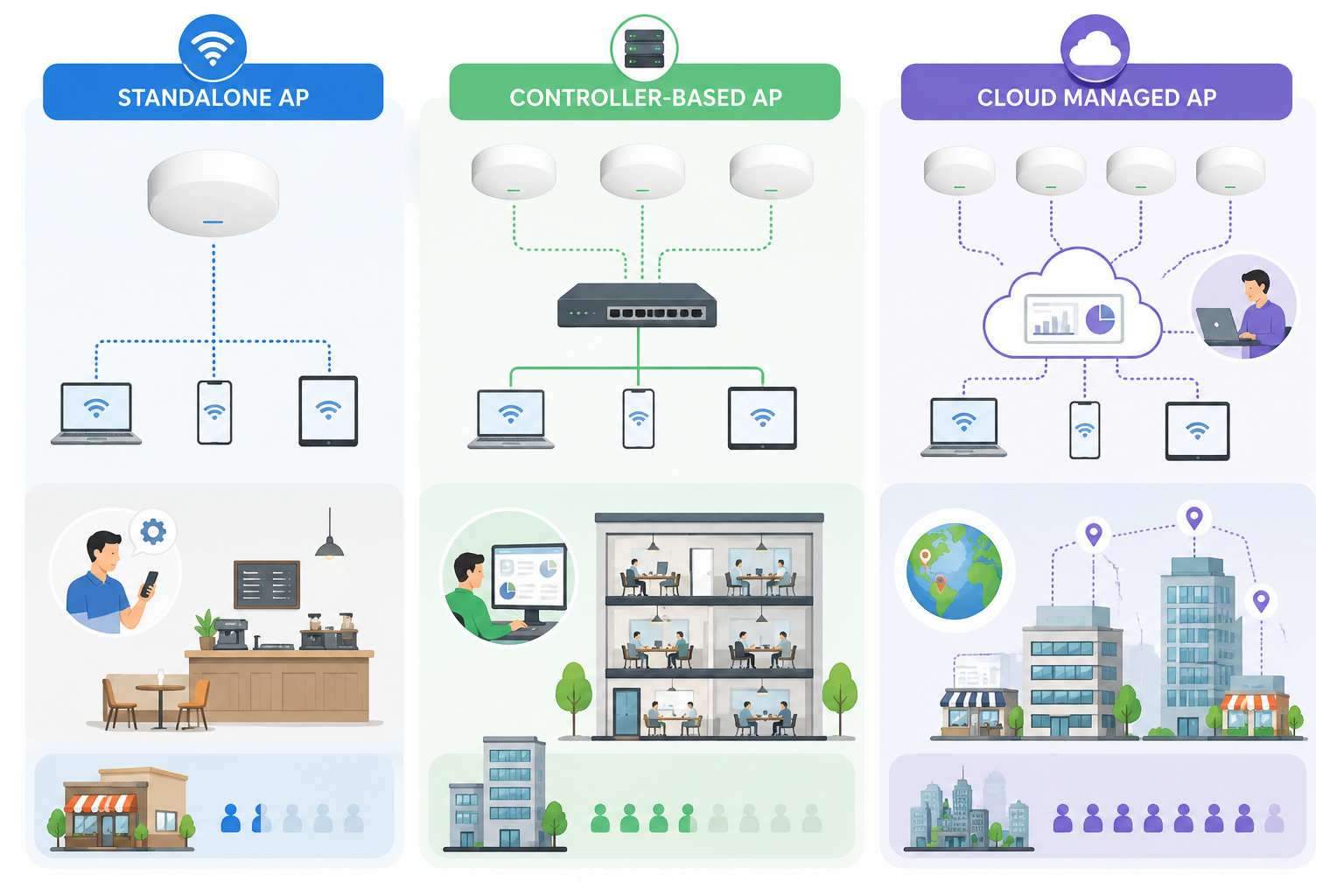
A Standalone Access Point is an AP that operates independently. Each unit has its own configuration system. Administrators must configure each device individually, such as setting up the SSID, Password, VLAN, or Security Policy.
This type of Access Point is suitable for small networks with a limited number of APs that do not require complex management systems, such as residences, retail shops, or small offices.
Advantages of Standalone AP
- Easy to install
- Low cost
- No central controller required
- Ideal for small-scale systems
Limitations of Standalone AP
- Must configure each unit separately
- Difficult to manage multiple APs
- Roaming might be incomplete
- Limited future scalability
Example locations suitable for Standalone AP
- Residences
- Small coffee shops
- Retail stores
- Home offices (SOHO)
- Small offices
What is a Controller-Based Access Point?
A Controller-Based Access Point is a Wi-Fi system that manages all Access Points through a central Controller. The Controller acts as the central hub to control, configure, and manage the Wi-Fi network, making the maintenance of a large number of systems easier and more efficient.
This type of system is suitable for medium to large organizations that have many Access Points and require a high-stability Wi-Fi system supporting Fast Roaming, Load Balancing, and enterprise-level Security.
Advantages of Controller-Based AP
- Centralized management for multiple APs
- Supports efficient Roaming
- Easy configuration of Security Policies
- Suitable for large-scale systems
- Handles a large number of users effectively
Limitations of Controller-Based AP
- Higher cost
- Requires a central Controller
- Increased system complexity
- Requires administrators with Network expertise
Example locations suitable for Controller-Based AP
- Hotels and resorts
- Hospitals
- Universities
- Large office buildings
- Industrial factories
- Shopping malls
What is a Cloud Managed Access Point?
A Cloud Managed Access Point is an AP system that can be managed through a Cloud system on the internet. Administrators can monitor status, configure, or troubleshoot Wi-Fi systems from anywhere via a Web Browser or Mobile Application without needing to be physically present at the organization.
Cloud Managed Wi-Fi is currently very popular in modern organizations because it reduces the IT Infrastructure burden and adds convenience in managing multiple branches simultaneously.
Advantages of Cloud Managed AP
- Can be managed remotely
- Real-time network status monitoring
- Configure multiple branch APs simultaneously
- Reduces internal system maintenance burden
- Supports automatic Monitoring and Alerts
- Ideal for organizations with multiple branches
Limitations of Cloud Managed AP
- Requires an internet connection
- Some systems require an annual Subscription fee
- Dependent on the Cloud Platform provider
Example locations suitable for Cloud Managed AP
- Multi-branch businesses
- Chain store restaurants
- Hotel groups
- Co-working Spaces
- Franchise Businesses
- Smart Buildings
- Organizations with limited IT staff
Standalone AP vs Controller-Based AP vs Cloud Managed AP: What are the differences?
Although all 3 formats serve the same function of distributing Wi-Fi signals, they differ clearly in terms of management:
· Standalone AP: Suitable for small systems, easy to install, and low cost, but difficult to manage multiple devices.
· Controller-Based AP: Suitable for large organizations requiring high stability, centralized management, and supporting a high number of users.
· Cloud Managed AP: Suitable for modern organizations that want to manage Wi-Fi systems via Cloud and maintain multiple branches remotely.
Why is it important to choose the right Access Point management system?
In the past, Wi-Fi installation might have consisted of only 1-2 points. Today, most organizations have many Access Points and must support employees, customers, IoT devices, IP cameras, and various Smart Building systems.
Therefore, if an unsuitable management system is chosen, problems may arise such as:
- Difficulty in managing multiple points
- Delayed network troubleshooting
- Unstable Roaming
- Inconvenience in managing multiple branches
- Difficulty in future system expansion
Choosing the appropriate Management System helps the organization manage Wi-Fi more easily, increases system stability, and supports long-term business growth.
Summary of Categorizing Access Points by Management Format
Categorizing Access Points by Management Format (Management System) is another important factor in Wi-Fi system design. It can be divided into:
- Standalone Access Point for small-scale systems
- Controller-Based Access Point for large organizations
- Cloud Managed Access Point for modern organizations needing Cloud management
Choosing the right system not only makes the Wi-Fi network more stable and secure, but also reduces the burden on IT management and increases the efficiency of organizational network maintenance in the long run. This is especially true for hotels, hospitals, offices, factories, and Smart Buildings where the network system has become the heart of digital business operations.


