Published: 12 Jan 2026 by: Rungrueng Hounraluek
What Is the Impact on Satellite Systems When C-Band Is Used for 5G?
When One 5G Spectrum Must Serve Two Worlds
As 5G networks become a core infrastructure of the digital economy, C-Band spectrum has been reallocated in many countries to support terrestrial telecommunications services. Historically, however, C-Band has been the backbone of satellite communications, particularly for broadcasting and mission-critical infrastructure networks.
This transition is not merely a technical adjustment, but a fundamental shift in spectrum resource balance that directly affects satellite system stability and service quality worldwide. The key question is therefore not only whether C-Band can be used for 5G, but how satellite systems will be impacted and how stakeholders should systematically prepare for coexistence.
C-Band: From Satellite Spectrum to a Strategic 5G Resource
Traditionally, C-Band satellite services operate in the 3.74.2 GHz downlink and 5.9256.425 GHz uplink ranges, which have long been used for highly reliable broadcasting and backbone communication systems.
In the 5G context, many countries have allocated nearby frequenciesparticularly 3.34.2 GHzas mid-band 5G spectrum due to its optimal balance between speed, coverage, and infrastructure cost. The use of overlapping spectrum by two fundamentally different transmission systems introduces significant coexistence challenges.
Five Key Impacts on Satellite Systems
- Risk of Signal Interference 5G base stations operating in C-Band transmit at high power and are often located close to satellite earth stations, creating interference risksespecially for highly sensitive earth stations. This may result in degraded signal quality or intermittent service outages.
Possible approaches include (a) parallel operation of both systems with appropriate power limits and guard bands, or (b) reallocating C-Band satellite TV services to Ku-Band, terrestrial TV, or alternative platforms. - Service Reliability Uncertainty One of C-Bands strengths is its resilience to weather conditions. However, when satellite TV and 5G operate concurrently, the increasingly dense RF environment can impact satellite reliability, making it more challenging to maintain traditional service quality standards.
- Infrastructure Adaptation Costs Satellite operators and broadcasters must invest in upgraded filters, new receiving equipment, and partial migration to Ku-Band or terrestrial platforms. These costs include not only hardware, but also system redesign and migration expenses, directly affecting the satellite broadcasting industrys cost structure.
- Impact on Broadcasting and Public Utility Networks In many countries, satellite broadcasting serves as a backup communication network during emergencies or natural disasters. Any degradation in C-Band stability may therefore affect national communication resilience at a structural level.
- Pressure to Accelerate Technology Transition The adoption of C-Band for 5G forces satellite operators to accelerate migration toward Ku-Band for broadcasting and Ka-Band for satellite broadband services. While these bands offer higher capacity, they are more susceptible to rain fade and require more complex system design.
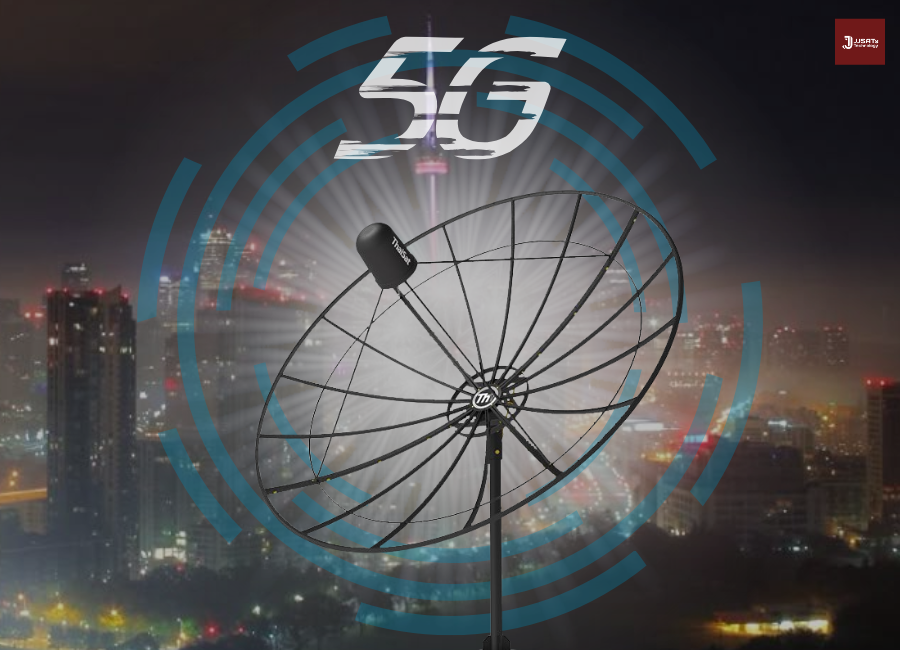
Mitigation Measures for the Coexistence of Satellite TV and 5G
- Technical Measures Such as defining guard bands, installing high-quality RF filters, limiting base station transmission power near earth stations, and establishing protection zones.
- Policy Measures Including spectrum coexistence guidelines between 5G and FSS, financial support for satellite system migration, and clearly defined transition timelines to minimize impact on existing users.
- Organizational and Strategic Measures Such as hybrid network planning (integrating satellite and terrestrial networks), investment in adaptive modulation and coding technologies, and long-term communication risk management strategies.
References
- International Telecommunication Union. (2020). Guidelines for IMT-2020 (5G) in mid-band spectrum.
- CEPT. (2019). Compatibility between 5G and satellite services in the C-band.
- Federal Communications Commission. (2020). Expanding flexible use of the 3.74.2 GHz band.
- GSMA. (2021). C-band: The backbone of 5G.
- Maral, G., & Bousquet, M. (2011). Satellite communications systems. Wiley.


