

Published: Jan 6, 2026 By: Rungrueang Huanraluek
Consumer TV and Commercial TV may look very similar on the outside, but they are designed for "entirely different contexts of use" in terms of technical specifications, lifespan, warranty, and suitability for business or organizational use. Choosing the wrong type can directly impact your business image, operational stability, long-term costs, and warranty conditions.
Consumer TV is designed for household use, focusing on personal entertainment experiences. Since Consumer TVs are intended for private use, when a user logs into various applications such as Netflix, YouTube, Google Accounts, or other streaming services, the system will automatically remember the Username and Password after the first login. This convenience allows the owner to access services immediately next time without re-entering credentials. This mechanism is ideal for home use, where design priorities are picture quality, sound, smart features, and affordability, based on an assumption of a few hours of use per day in controlled environments like living rooms or bedrooms.
Commercial TV is designed for commercial or enterprise (B2B) use, such as in hotels, hospitals, shops, offices, government agencies, and digital signage. The key focus is not just image quality, but "durability, stability, and centralized control." Commercial TVs are built for continuous long-term operation, supporting system lock settings (Commercial/Hotel Mode) and compatibility with external software or systems. Commercial TVs are designed with "frequent user turnover" in mind. Therefore, they include special modes like Hotel Mode or Commercial Mode that control TV behavior, preventing long-term storage of user data and allowing the system to reset application states and user information every time a guest checks out or the system restarts. This reduces privacy risks and aligns with security standards in the hospitality industry. In business terms, a crucial difference is the warranty terms and compliance. Most manufacturers will void the warranty of a Consumer TV if used for commercial purposes (e.g., in hotels, restaurants, or offices), whereas Commercial TVs are specifically designed and warrantied for such use, including support for Bulk Management and network integration.
In conclusion, Consumer TV is suitable for "Home," while Commercial TV is suitable for "Business and Organizations." Although the initial cost of a Commercial TV may be higher, it offers better value, reliability, stability, and long-term standard complianceespecially for hotels and organizations requiring continuous service. If you want to know the impact of using a Consumer TV instead of a Commercial TV, you can find more information in our upcoming articles.
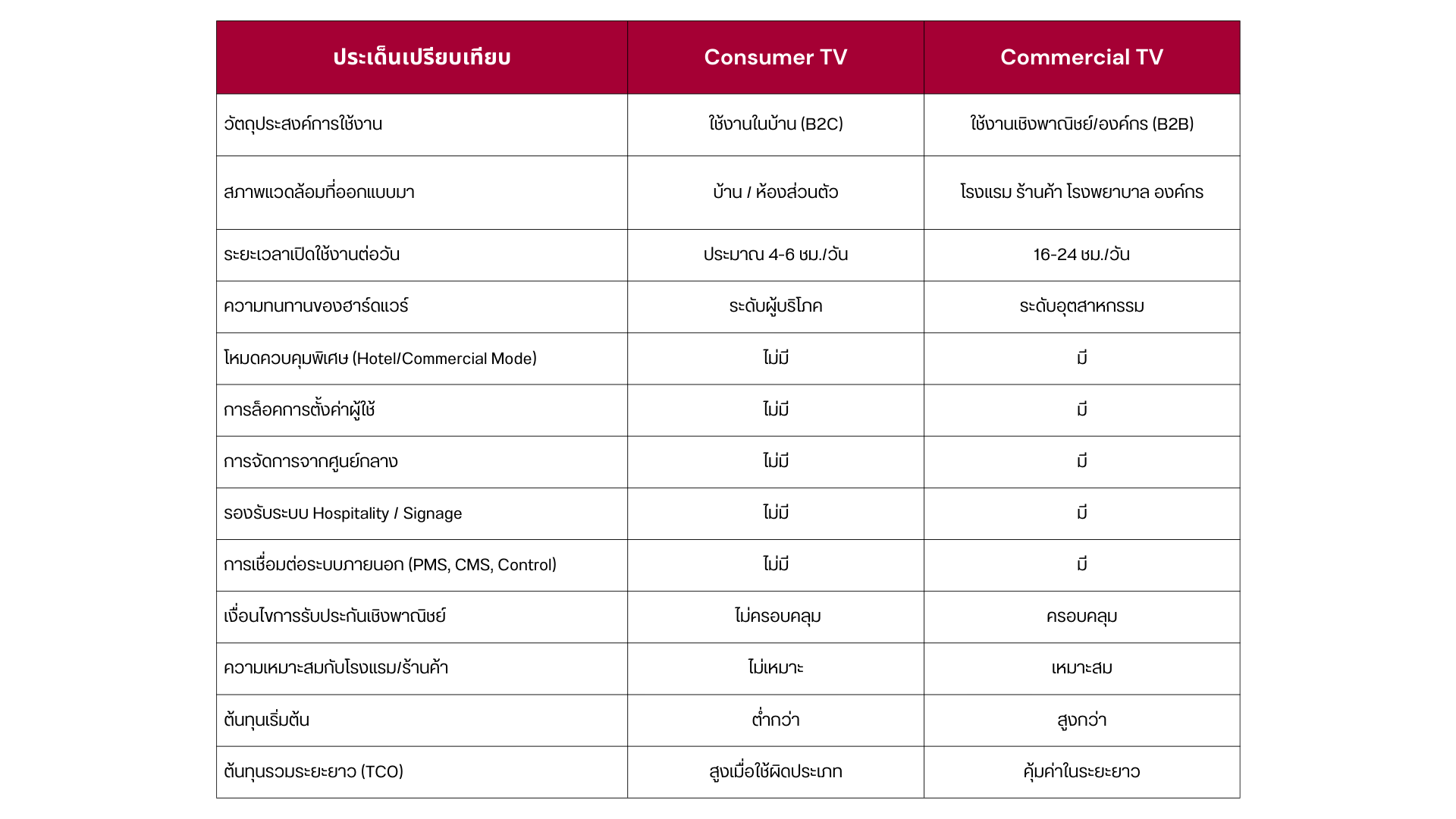
Comparison Table: Consumer TV vs Commercial TV


