

Published: May 13, 2026 By: Rungruang Huanraluek
What are LAN, MAN, and WAN? Understanding "Network Structures" the Easiest Way
What are LAN, MAN, and WAN? Systematically Understanding "Network Structures"
In today's digital world, where businesses inevitably rely on the internet and information technology systems, understanding Network Infrastructure is no longer limited to engineers or technical experts. It is essential knowledge for executives who need to see the big picture of total system connectivity and the roadmap for developing network structures that align with future organizational growth.
Fundamentally, network structures can be classified into three key levels: LAN (Local Area Network), MAN (Metropolitan Area Network), and WAN (Wide Area Network). Each level serves a different scope and role but works together in a hierarchical mannercomparable to connecting from a "building level (home)" to a "city level" and expanding to a "global level"to ensure seamless communication and data exchange in every dimension of business and daily life.
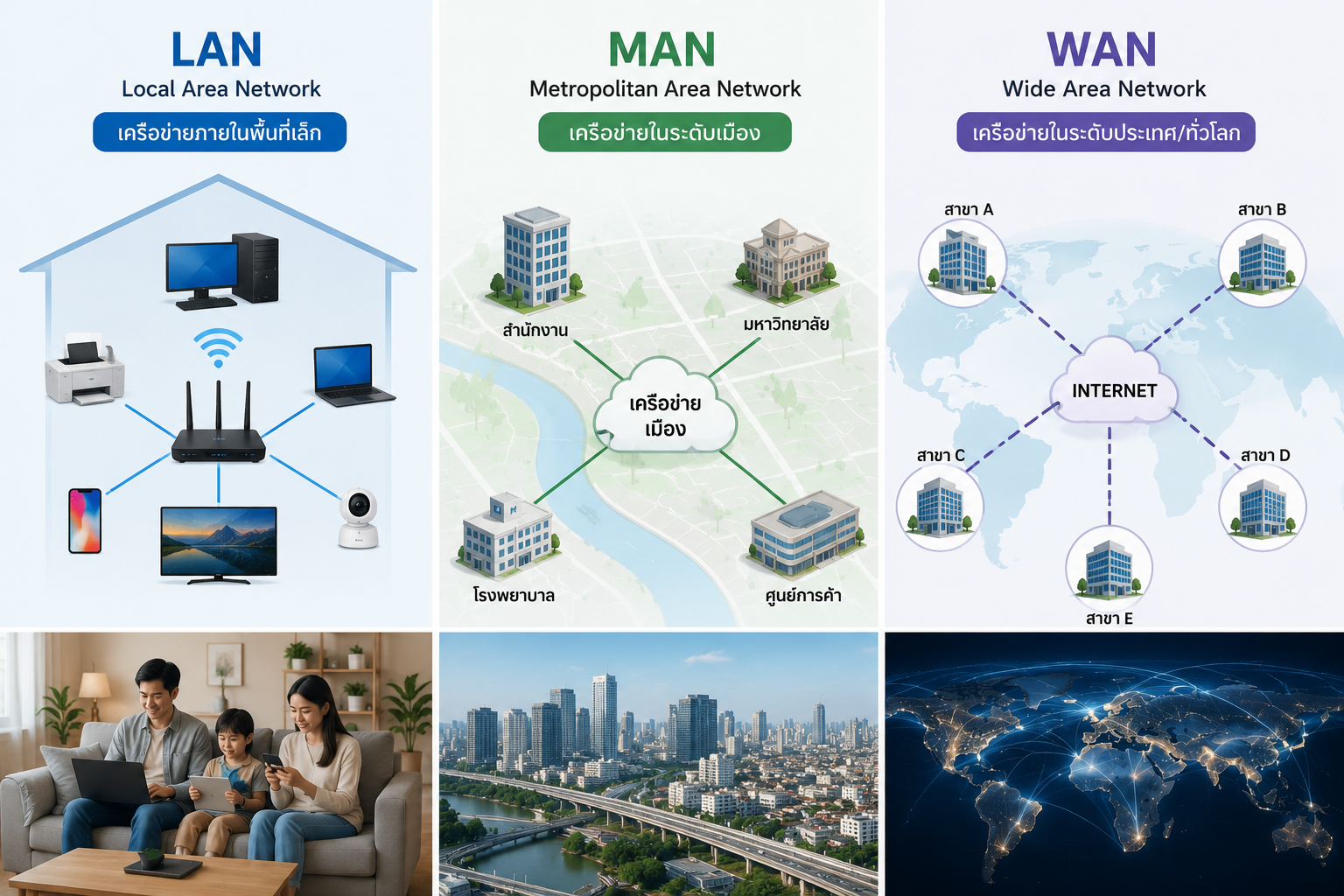
LAN (Local Area Network): Building-Level Network
LAN (Local Area Network) is a computer network designed for use within a limited area, such as a residence, office, hotel, or industrial plant. It functions by connecting various devices togetherincluding computers, wireless networks (Wi-Fi), IPTV systems, IP Phones, and IP Camerasto enable efficient communication and data exchange.
In a hotel context, various internal systems such as guest room IPTV, guest Wi-Fi, security CCTV, and the Property Management System (PMS) are all linked and operate through a LAN structure.
The key strength of a LAN is its high speed and stability. Since communication occurs over a short distance, it is ideal for internal organizational use that requires performance and continuity, such as video streaming, video conferencing, or real-time processing systems.
MAN (Metropolitan Area Network): City-Level Network
MAN (Metropolitan Area Network) is a network designed to connect several smaller LANs together across a large area, such as a city or province. This is commonly found in organizations with multiple branches in the same region, such as hotel chains, university campuses, or government agencies with buildings scattered across a city that need a central network for data sharing and management.
In comparison, a MAN is like a "city road network" that connects "houses" (individual LANs) together systematically. It relies on core technologies like Fiber Optics and Metro Ethernet, which can support high-speed data transmission over a wide urban area.
The major advantage of a MAN is that it allows organizations with multiple branches to operate seamlessly. They can share resources such as centralized servers or Data Centers, which increases management efficiency, reduces system redundancy, and supports long-term organizational expansion sustainably.
WAN (Wide Area Network): Global-Level Network
WAN (Wide Area Network) is a network that covers a broad area, from a country level to a continental or global level. It plays a vital role in linking a vast number of smaller networks together. The most prominent example of a WAN is the Internet, which serves as the primary infrastructure for communication and data exchange in the digital age.
For organizations, a WAN is crucial for connecting headquarters with remote branches located in different provinces or countries, allowing for continuous communication, data access, and system usage regardless of physical distance.
Today, WANs have evolved beyond basic connectivity and are closely linked to modern technologies like Cloud Computing (e.g., AWS, Microsoft Azure), remote work solutions, and SD-WAN technology, which enhances network management by making it more flexible, secure, and intelligently adaptive to usage conditions.
Overview: The Interconnectivity of LAN, MAN, and WAN
To visualize how these three network levels work together, consider a hotel business scenario: When a guest uses Wi-Fi in their room, the connection happens via the LAN (internal building network). If that hotel has multiple branches in the same city, data sharing between them relies on a MAN. Finally, when the hotel system connects to global booking platforms or online services, the WAN plays the essential role of linking all systems across any distance.
Therefore, these three network levels function in a Layered Architecture, starting from the small internal scale (LAN), expanding to the city scale (MAN), and extending to the national or global scale (WAN). Designing a system with a proper understanding of these layers allows an organization to develop efficient IT infrastructure that is scalable and meets the demands of the digital era sustainably.


