

Published: January 7, 2026 by: Rungrueng Hounraluek
Using Consumer TV in place of Commercial TV in service-oriented businesses may be technically feasible in the short term. However, from a system design, operational management, and service ethics perspective, it can lead to several significant impactsespecially in hotels, resorts, hospitals, and serviced apartments, where users change frequently and guest privacy is a critical concern.
Consumer TVs are designed for personal home use and therefore tend to remember user identity, such as storing usernames and passwords after the first login to streaming applications. This allows the device owner to continue using the TV conveniently without re-entering credentials. While this behavior is suitable for a home environment, when used in public spaces like hotels, the TV effectively becomes a personal device of one guest rather than a shared device of the establishment, creating a risk that account information and viewing history may be exposed to the next guest.
The first major impact is the risk to personal data and privacy. Guests may forget to log out of services such as Netflix, YouTube, or Google accounts, allowing subsequent guests to access those accounts, view usage history, or even continue using paid services. This directly relates to personal data protection laws (such as PDPA) and can severely damage a hotels reputation.
The second impact concerns service ethics. Hotels have a responsibility to protect the privacy of every guest. Using Consumer TVswhich are designed to automatically retain user datameans deploying equipment that is fundamentally unsuitable for public environments. This may be perceived as neglecting basic service standards, even if unintentional.
The third impact is the limitation in system management. Consumer TVs do not support Hotel Mode or centralized management systems, making it impossible to lock menus, automatically reset settings after check-out, or efficiently manage large numbers of TVs. As a result, staff must manually configure, troubleshoot, and reset each TV room by room, increasing long-term operational expenses (OPEX).
The fourth impact involves warranty conditions and business risk. Most manufacturers clearly state that Consumer TVs are not covered by warranty when used for commercial purposes. If damage occurs due to continuous operation or usage outside a home environment, the hotel must bear all repair or replacement costs independently.
In summary, while using Consumer TV instead of Commercial TV may appear to reduce initial investment costs, it introduces significant long-term risks related to data security, credibility, brand image, and hidden operational costs. In contrast, Commercial TV and Hospitality TV are purpose-built as public-use devices, supporting user reset functions, centralized control, and proper business usageboth technically and ethically.
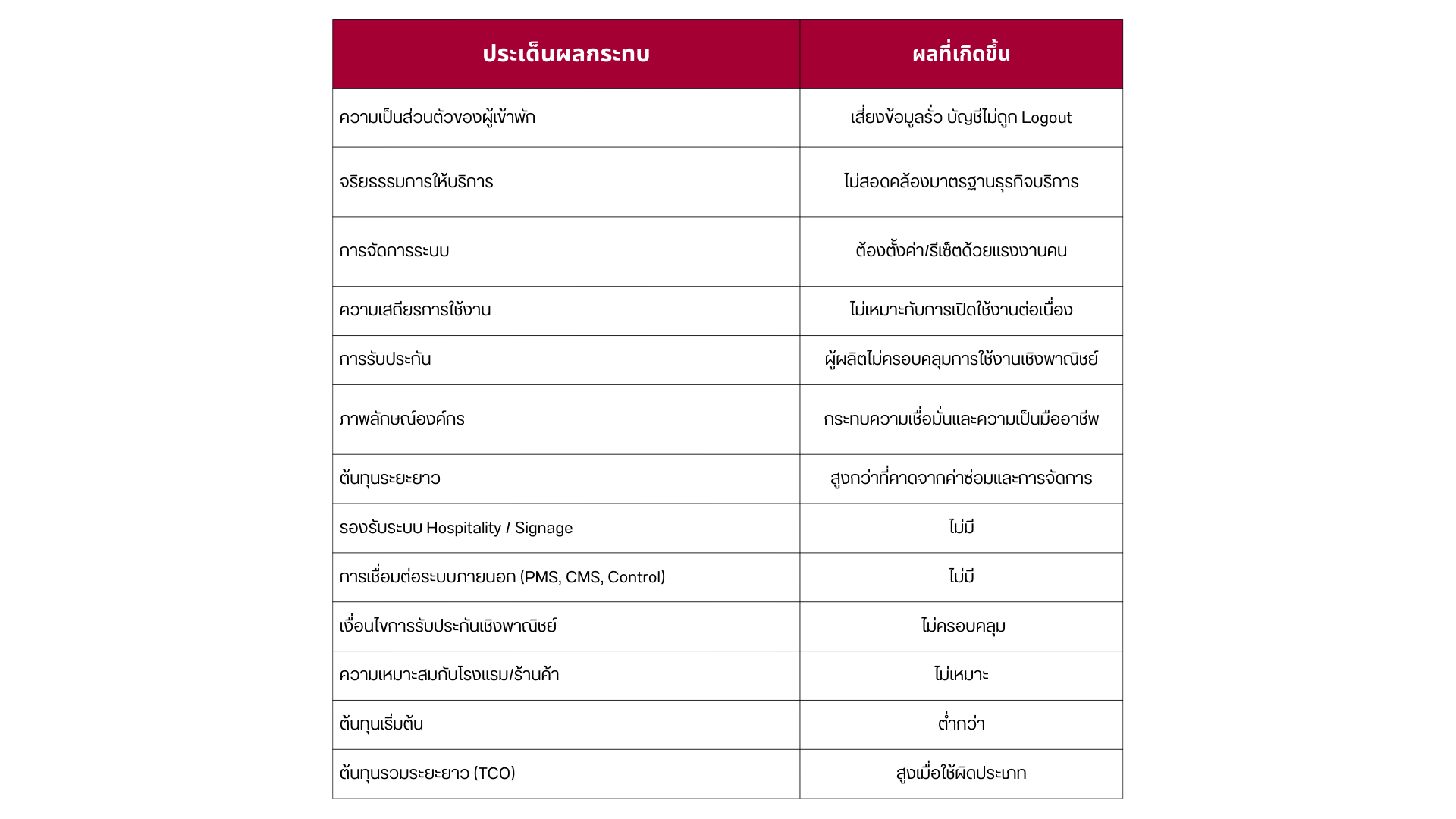
Summary of the impacts when using Consumer TV instead of Commercial TV


